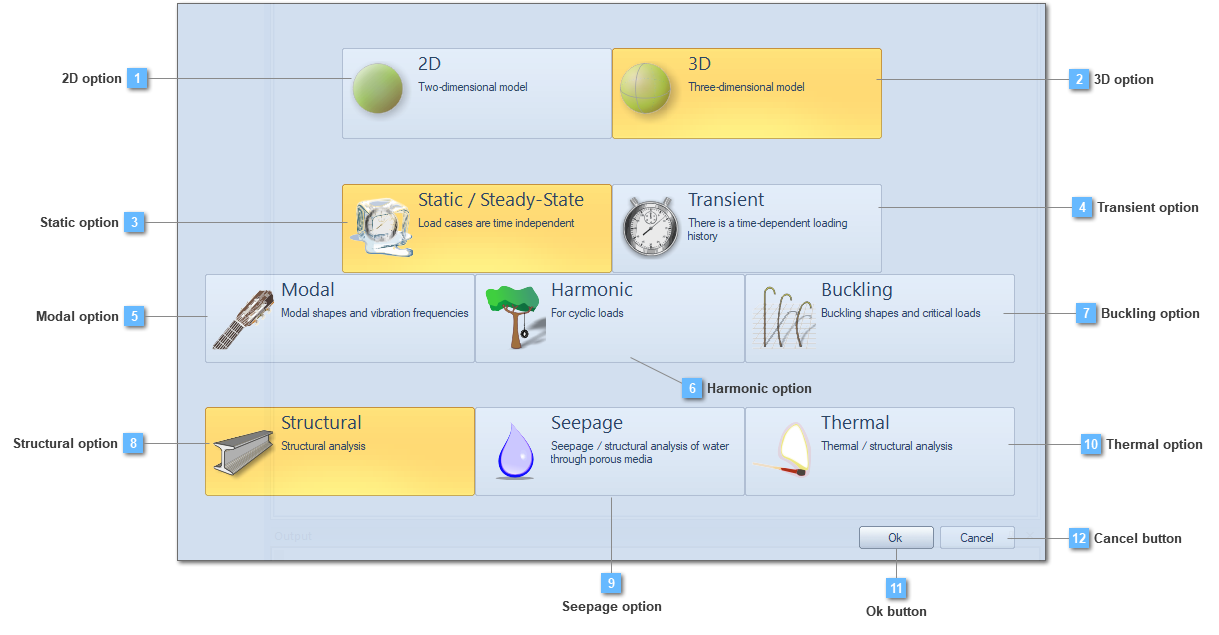
Buckling option
Evaluation of structural buckling must be taken into account due to the importance of this effect in slender structures that could cause the a structural failure. Buckling happens suddenly, without little if any prior warning, so there is almost no chance for corrective action.
Buckling of a structure happens when the stiffness matrix approaches a singular value. You can extract the eigenvalue in a linear analyses to obtain the linear buckling load. You can also perform eigenvalue analysis for a buckling load in a nonlinear problem based on the incremental stiffness matrices.
Inside the internal structure of a buckling analysis, it is also possible to perform either a linear buckling analysis or a non-linear buckling analysis, depending on the structural composition.
Linear buckling analysis.
First, consider a linear-buckling analysis (also called eigenvalue-based buckling analysis), that is in many ways similar to a modal analysis. Linear buckling is the most common type of analysis and is easy to execute, but it is limited in the results it can provide.
Linear buckling analysis calculates the buckling load magnitudes that cause buckling and associated buckling modes.
FEA (finite element analysis) programs provide calculations of a large number of buckling modes and the associated buckling-load factors (BLF). The BLF is expressed by a number that factored by the applied load gives the total buckling-load magnitude.
The buckling mode presents the shape the structure assumes when it buckles in a particular mode, but says nothing about the numerical values of the displacements or stresses. The numerical values can be displayed, but are merely relative. This is in close analogy to modal analysis, that calculates the natural frequency and provides qualitative information on the modes of vibration (modal shapes), but not on the actual magnitude of displacements.
Theoretically, it is possible to calculate as many buckling modes as the number of degrees of freedom in the FEA model. Most often, though, only the first positive buckling mode and its associated BLF need be found. This is because higher buckling modes have no chance of taking place — buckling most often causes catastrophic failure or renders the structure unusable.
Nonlinear buckling analysis.
As with any other nonlinear analysis, nonlinear-buckling analysis requires that a load is applied gradually in multiple steps rather than in one step as in a linear analysis. Each load increment changes the structure shape, and this, in turn, changes the structure stiffness. Therefore, the structure stiffness must be updated at each increment.
When buckling happens, the structure undergoes a momentary loss of stiffness and the load control method would result in numerical instabilities. Nonlinear buckling analysis requires another way of controlling load application. Here, points corresponding to consecutive load increments are evenly spaced along the load-displacement curve, which itself is constructed during load application.
In contrast to linear-buckling analysis, that only calculates the potential buckling shape with no quantitative values of importance, nonlinear analysis calculates actual displacements and stresses.
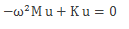
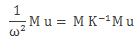
The buckling option solves the following eigenvalue problem by either the inverse power sweep or the Lanczos method:
Where  is assumed to be a linear function of the load increment is assumed to be a linear function of the load increment  to cause buckling. to cause buckling.
The geometric stiffness used for the buckling load calculation is based on the stress and displacement state change at the start of the last increment. However, the stress and strain states are not updated during the buckling analysis.
| 













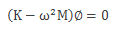
 are the eigenvalues (frecuencies) and
  are the eigenvectors. In CivilFEM, if the extraction is performed after increment zero, K is the tangent stiffness matrix, which can include material and geometrically nonlinear contributions. The mass matrix is formed from both distributed mass and point masses.